
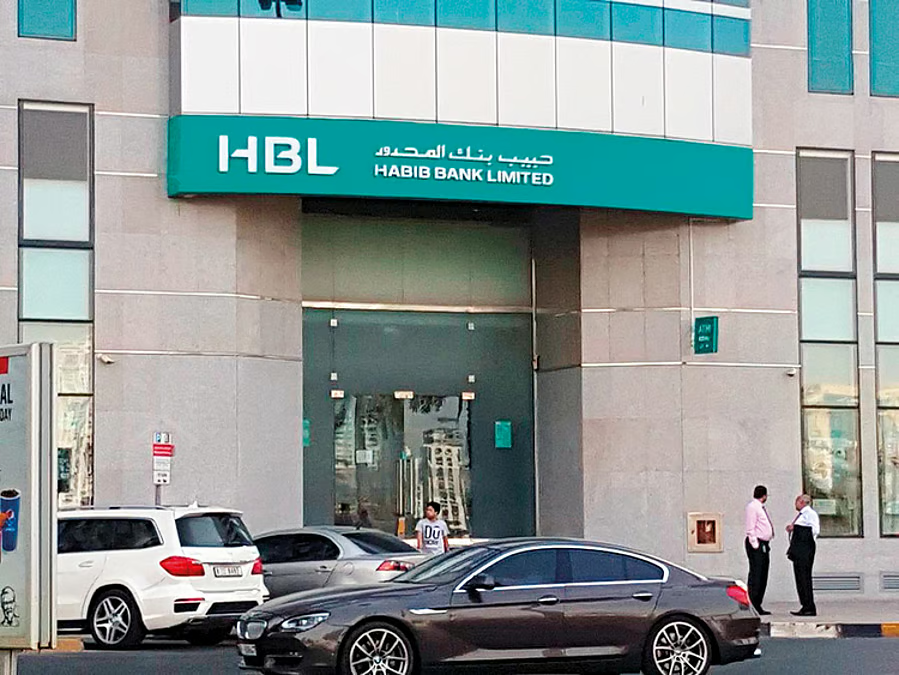
As Pakistan steps into 2026, the country faces a pivotal moment of economic, social, and technological transformation. After years of macroeconomic turbulence and structural reforms, Pakistan’s banking sector is positioned to play a central role in the next phase of national growth. Despite significant progress in digital payments and branchless banking, nearly half of Pakistan’s adult population remains outside the formal financial system—presenting both a challenge and a tremendous opportunity for inclusive banking.
Habib Bank Limited (HBL), Pakistan’s largest and most globally connected bank, is accelerating its mission to bring these previously unbanked populations into the formal economy. By 2026, HBL recognizes that sustainable growth depends not only on corporate and multinational clients but also on small traders, rural households, women entrepreneurs, and gig-economy workers.
Related: How Can Islamic Social Finance Help The Needy?
Financial inclusion at the grassroots
HBL’s inclusive banking strategy has evolved over the past decade. In 2025–26, the bank has expanded its digital and rural outreach, offering biometric onboarding, micro-savings accounts, women-focused products, and agricultural financing. Strategic partnerships with fintechs allow HBL to reach previously inaccessible communities, bridging gaps in trust, literacy, and access.
Groundbreaking initiatives, including instant digital transfers, agent banking, and simplified mobile apps, are enabling a transition from cash-heavy systems to secure, transparent financial channels. HBL has also increasingly incorporated behavioral insights into its product design, ensuring that services reflect the real-world financial habits of underserved populations.
Navigating a changing competitive landscape
The withdrawal and downsizing of foreign banks in Pakistan over the last decade has given local institutions unprecedented opportunities. HBL leveraged this by acquiring Citibank’s retail operations and Barclays’ Pakistan branch, strengthening its position in corporate and investment banking.
As of early 2026, Pakistan’s banking sector continues to be highly profitable. Total assets have expanded further, with digital channels now accounting for the majority of transactions. Capital adequacy remains robust, well above regulatory thresholds, even as banks navigate global compliance and regulatory challenges.
Islamic finance drives inclusion and growth
Islamic finance continues to gain momentum. By 2026, Islamic banking assets account for over 22 percent of the total banking sector, and nearly all major banks operate Sharia-compliant divisions. These products have facilitated inclusion for segments of the population previously hesitant to engage with conventional banking.
HBL’s Islamic banking division has become the country’s second-largest, with growth spanning retail, SME finance, trade financing, and project finance. The Karachi Stock Exchange (now part of the Pakistan Stock Exchange) continues to expand Sharia-compliant investment products, while the Central Bank maintains a robust regulatory framework for Islamic finance.
Technology and digital transformation
Technological disruption has accelerated in Pakistan, with fintechs and digital service providers offering faster, more efficient alternatives to traditional banking. By 2026, bank–fintech collaboration is standard, and HBL has invested heavily in AI-powered fraud detection, predictive credit scoring, and cloud-based core banking.
Consumer expectations have evolved: seamless interactions via mobile apps, WhatsApp banking, and online platforms are now essential. HBL’s investment in digital infrastructure ensures it remains competitive while expanding financial literacy and inclusion.
CPEC and regional economic opportunities
The China-Pakistan Economic Corridor (CPEC) remains a central driver of economic activity. In 2026, projects have expanded beyond energy and infrastructure into industrial zones, logistics hubs, agri-tech, and digital connectivity.
HBL continues to play a key role in financing CPEC projects. Its branch in China is operational, supporting cross-border trade, project finance, and advisory services. CPEC is expected to significantly boost GDP, trade, and employment over the next decade, and HBL is positioned as a critical financial intermediary.
Women, rural banking, and future growth
HBL’s HBL Nisa initiative, launched with IFC support, has expanded women’s access to banking, micro-insurance, and entrepreneurial financing. Rural banking remains a key focus, with HBL supporting agricultural technology, microfinance, and community credit programs. Year-on-year rural banking growth has remained strong, reflecting the bank’s commitment to long-term financial inclusion.
HBL’s strategy for 2026 and beyond centers on inclusive, technology-driven growth. Its focus on corporates, Islamic finance, digital banking, women’s financial empowerment, and rural inclusion positions the bank at the forefront of Pakistan’s financial transformation.
By integrating global expertise with local knowledge, HBL is enabling millions of previously unbanked Pakistanis to access formal financial services, participate in economic growth, and secure their financial futures. The next five to ten years promise to redefine Pakistan’s banking landscape, and HBL is determined to remain at its center.
Author

Help Us Empower Muslim Voices!
Every donation, big or small, helps us grow and deliver stories that matter. Click below to support The Halal Times.
 How Hana Tajima Redefined Modest Fashion—and Helped Uniqlo Change a Global Market
Leave a Reply